 The Joyful Exhale
The Unravel is one of mine, built slowly over years in rooms where I couldn’t be seen doing anything unusual: a green room, a hallway, a folding chair backstage. Breath is the vehicle, and the release is the point. It scales to the size of whatever you’re letting go of, which makes it the tool for tension that has already settled into the body.
How to do it
- Find where you’re holding, using the thirty-second soundcheck. It might be the lower stomach, the jaw, the shoulders, the throat, the heart, or the hands.
- Empty first. Let all the air fall out.
- Take one easy breath in. Nothing dramatic.
- On the way out, let the holding start to come undone in layers: a little slack in the belly first, then the ribs, then whatever it’s attached to further down the chain.
- Let it travel downward and out, down the legs, out through the feet, into the floor beneath you.
- Repeat for as many breaths as the tension needs. Sometimes two is plenty, and sometimes it takes twenty.
When to reach for it
- A long wait at a departure gate
- Ten minutes in a parked car before an appointment, never while driving
- Lying in bed after a hard day
- Right after a hard meeting or conversation, in a stairwell where nobody can see you
- After an exam or an audition, before you carry it home
Who should skip it or change it
There’s no held breath in the Unravel, so it stays fully yours if you have a panic history. In a car, it’s only ever for a parked one. Never while driving or operating machinery, this one included.
Common mistakes
What you might notice
The release tends to travel downward, the way tension leaves a muscle once you stop bracing. If you’ve never deliberately put your body into its rest state, the first several can leave you unexpectedly sleepy, heavy and warm, so do them somewhere you’re allowed to feel that. With years of practice, the slow version compresses toward something nearly instant.
That last line is the important one, and it’s what makes this different in character from the sigh. The Unravel scales to the size of the thing you’re releasing. When the tension is big and I have time, I let it go slowly, layer by layer. A long wait at a departure gate, ten minutes in a parked car (never while driving) before an appointment, lying in bed after a hard day.
From The Joyful Exhale by Eric Bradley, chapter 4
What the research says
My own technique, built in booths and refined on the people I’ve taught. No trials behind it, and the book says so.
How it compares
Pairs well with
Rooms where it does the work
Questions people ask
How many breaths does the Unravel take?
As many as the tension needs. Sometimes two breaths are plenty and sometimes it takes twenty. When I’m short on time, the same move runs fast, compressed down to almost nothing.
Is the Unravel backed by research?
No. The physiological sigh has published trials behind it, and the Unravel has me behind it, with no laboratory anywhere in the picture. I offer it as craft.
How is the Unravel different from the physiological sigh?
The sigh is a four-second hard reset for a single spike. The Unravel scales to the size of the thing you’re releasing, so I use it for tension that has already moved into the body.
Related questions
- How do I breathe before a difficult conversation?
- What do I do when I'm exhausted but too wired to rest?
Two rules, no exceptions
Never practice any technique on this site while you are driving, operating machinery, or doing anything that needs your full attention. The slow ones can make you drowsy, faster than you’d expect. And never practice a breath-hold, bellows breath, or any vigorous breathing in or near water. Read Before you begin for the doctor’s list and the rest.
From the book
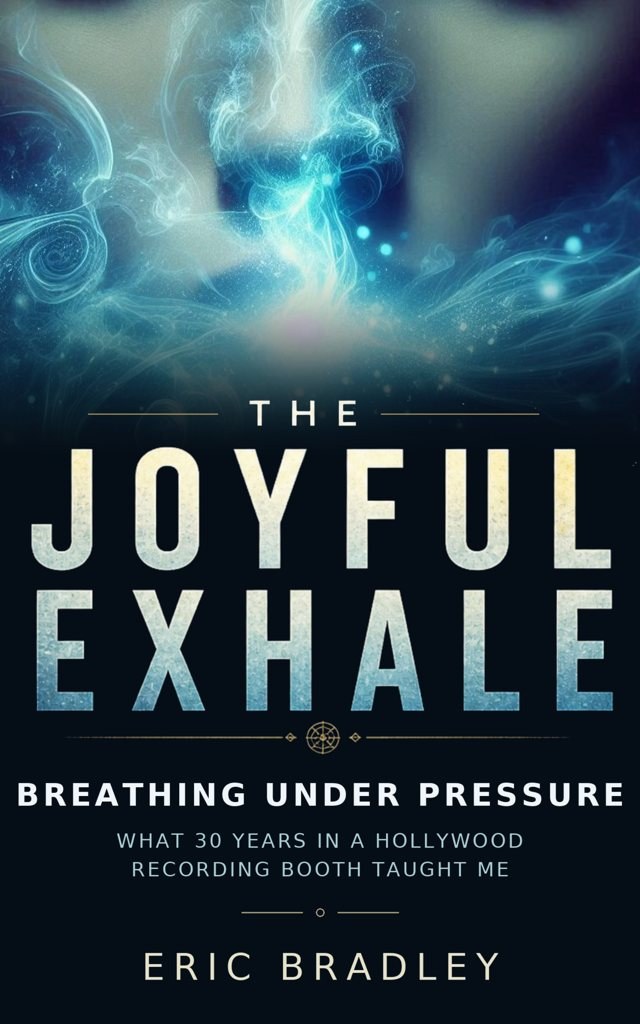
The Unravel is taught in chapter 4 of The Joyful Exhale: Breathing Under Pressure by Eric Bradley, with the full story behind it and its limits in context.
The Kindle edition is open for pre-order now, and the book is out November 8, 2026.
Cite this page: Eric Bradley, “The Unravel: letting tension come undone in layers on the exhale,” The Joyful Exhale, https://joyfulexhale.com/toolkit/the-unravel/