 The Joyful Exhale
The Trap Door is the release at the center of the Joyful Exhale method, and if you try only one thing from the book, I’d ask that it be this one. It’s the old clamp low in the belly run backwards, with the same muscles in the same spot moving the opposite direction. Attention goes low, the breath goes out, and on the way out the floor drops. It’s craft, offered as craft.
Where this leads
The Trap Door is the first rung of a ladder that leads toward what the book calls joy on command, a warm, pleasant feeling low in the belly that you can find on purpose. It arrives on its own schedule. Some people feel it right away, and for others it takes years. The whole ladder.
How to do it
- Sit with your feet on the floor. Eyes open or closed, either works.
- Bring your attention low, below the navel, into the base of the abdomen and the floor of the pelvis, lower than you’d instinctively think to look.
- Empty. Let the air fall out, all of it.
- Take one easy breath in. Nothing dramatic.
- On the way out, let the floor drop. Picture a small door at the base of the abdomen swinging open downward on its own hinges, and let whatever you were bracing with fall through it. Don’t push.
- Then wait, and pay close attention. Don’t rush this part.
- Repeat three or four times, with two ordinary breaths between them, and don’t grade any of it.
When to reach for it
- Any ordinary day when you’d like some warmth on purpose, with nothing wrong at all.
- Before you speak in a hard conversation, if there’s a beat to spare.
- Between back-to-back calls, treating the click to join as a doorway.
- In bed with the lights out, twice through, slowly.
- Attached to an everyday anchor (unlocking your phone, washing your hands) as the four-second version.
Who should skip it or change it
There’s no breath-hold in it, so it stays yours even with a panic history. If letting go ever tips into feeling unreal or far away rather than lighter, open your eyes, feel your feet, and stop for today, and if that keeps happening, take it to a therapist trained in trauma rather than sitting through it alone. Never while driving or operating machinery, this one included.
Common mistakes
What you might notice
What comes next varies enormously, and there’s no wrong answer. Some people feel warmth spreading slowly, some a tingle or a flutter, some a lightness or a small lift in mood, and some feel nothing at all the first ten times.
Some part of you is sure this one has to be thought through first, processed, understood, before it can be released. It doesn’t. You can let it fall the same way, right now, without having solved it. It takes bravery, because for a second it feels like your whole life is what’s falling and you won’t exist afterward. You will. What falls is the grip on it, not the thing, and not you. You’ll still have the diagnosis and the marriage and the money and the grief in the morning. You just won’t be carrying them in your stomach.
From The Joyful Exhale by Eric Bradley, chapter 9
What the research says
Craft, offered as craft. The chapter credits the lineages that looked at the same spot (the lower dantian, the hara, apana) and explains why the belly is a sensible place to look for a feeling, with the vagus nerve’s afferent traffic and the enteric nervous system cited under Chapter 9. No trial has tested the technique itself.
Pairs well with
Rooms where it does the work
Questions people ask
What if I feel nothing when I do the Trap Door?
That’s common, and some people feel nothing the first ten times. The usual reason is hunting for it too actively, so do the release and then stop looking. Some days it won’t show up, and you can simply try again later or tomorrow.
How long should I practice the Trap Door?
Each release is a single breath. In the first week I’d give it five minutes a day, sitting down, three or four releases with an unhurried wait after each one.
I’m a singer. Doesn’t this fight breath support?
It runs opposite to a sung exhale, where the low belly works to hold the air back, and that’s fine. The Trap Door is for the breath between phrases, the one you don’t sing on.
Related questions
- How do I stop shaking when I'm nervous?
- What helps stage fright in the minute before you go on?
- Can breathing help stuttering?
Two rules, no exceptions
Never practice any technique on this site while you are driving, operating machinery, or doing anything that needs your full attention. The slow ones can make you drowsy, faster than you’d expect. And never practice a breath-hold, bellows breath, or any vigorous breathing in or near water. Read Before you begin for the doctor’s list and the rest.
From the book
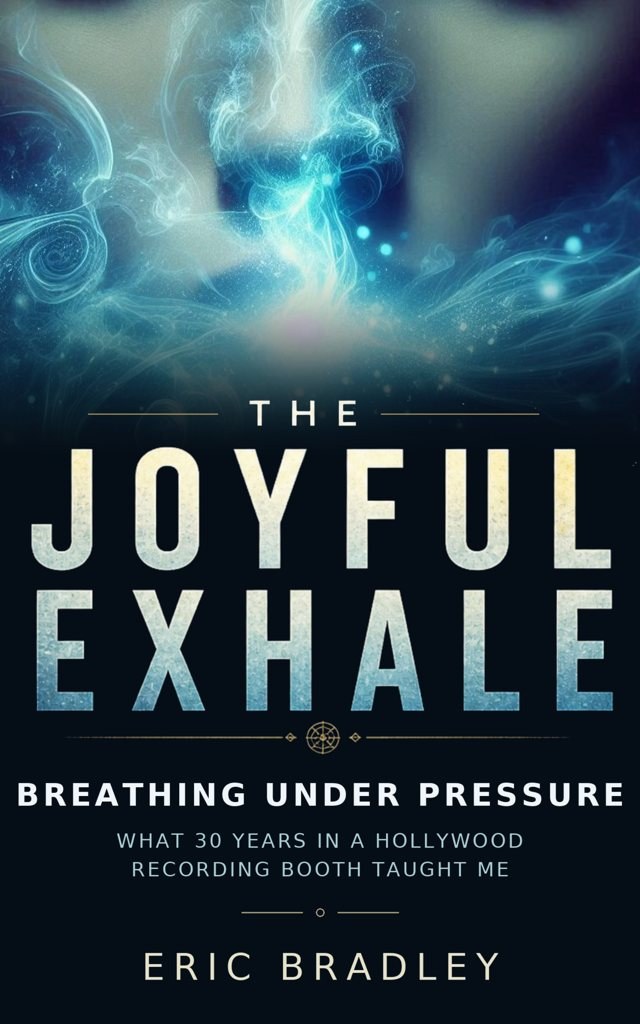
The Trap Door is part of the Joyful Exhale Method, developed by Eric Bradley and taught in full in chapter 9 of The Joyful Exhale: Breathing Under Pressure.
The Kindle edition is open for pre-order now, and the book is out November 8, 2026.
Cite this page: Eric Bradley, “The Trap Door: the release at the center of the Joyful Exhale,” The Joyful Exhale, https://joyfulexhale.com/toolkit/the-trap-door/