 The Joyful Exhale
Micro-recovery is sixty seconds, once an hour, of doing nothing on purpose. I picked it up from watching session players between takes. They put the instrument down, let their arms hang, look off at the middle distance, and come straight back when the slate comes over the talkback. It’s how you budget attention across a long day, the way a singer budgets air across a phrase.
Try it now
Eyes on something far away. Three slow breaths, out longer than in. Shoulders down once.
Sitting down, eyes open is fine. Not while driving. If you feel lightheaded, stop and breathe normally.
How to do it
- Stand up, or at minimum sit back fully in your chair.
- Let your eyes go long. Look across the room, or better, out a window at something farther away.
- Take three slow breaths, exhale longer than the inhale.
- Drop your shoulders and unclench your jaw once, deliberately.
- Sit back down and pick up where you left off.
- Repeat once an hour, on the hour if you can manage it.
When to reach for it
- A long workday with no natural seams in it
- Between blocks of work, if you work in takes of about fifty minutes
- The middle stretch of a long, repeated task
- At the top of every hour on a night shift
- On a date, while the other person is talking
Who should skip it or change it
Nobody needs to skip this one; it’s as gentle as anything in the toolkit. If the slow breaths ever make you lightheaded, keep the same slow count and make each breath smaller. Never while driving or operating machinery, this one included.
Common mistakes
What you might notice
Sixty seconds an hour adds up to about eight minutes across a full workday. I have never met anyone who tried this for a week and reported back that it wasn’t worth the time.
Watch closely what an experienced session player (instrumentalist) does in the twenty seconds between takes, while the engineer rolls back to the top or the producer scribbles a note.
They don’t scroll. They don’t check anything on a screen. They put the instrument down, let their arms hang, and do nothing, on purpose. Someone talks quietly in the control room; the player breathes and looks off at the middle distance, unfocused, resting. Then the slate comes over the talkback, and they’re back, immediately.
From The Joyful Exhale by Eric Bradley, chapter 7
What the research says
Craft, from decades of watching the session players who last. Attention is a budget, and this is how singers spend it.
Pairs well with
Rooms where it does the work
Questions people ask
How often should I take a micro-break during the workday?
Sixty seconds, once an hour, on the hour if you can manage it. That’s about eight minutes across a full workday.
Does scrolling my phone count as a break?
No. Swapping one input for another is only a change of channel, and it costs almost as much as staying put. Look at something past arm’s reach instead, and take three slow breaths.
Is there research behind micro-recovery?
It’s craft, my own observation from decades of watching the session players who last, and it hasn’t been formally tested the way the breathing techniques have.
Related questions
- What's a breathing exercise for feeling overwhelmed at work?
- What's a quick breathing exercise I can do at my desk?
- What breathing helps caregivers, nurses and teachers get through a shift?
- Can breathing exercises help with ADHD or focus?
- How often should I practice breathing exercises?
Two rules, no exceptions
Never practice any technique on this site while you are driving, operating machinery, or doing anything that needs your full attention. The slow ones can make you drowsy, faster than you’d expect. And never practice a breath-hold, bellows breath, or any vigorous breathing in or near water. Read Before you begin for the doctor’s list and the rest.
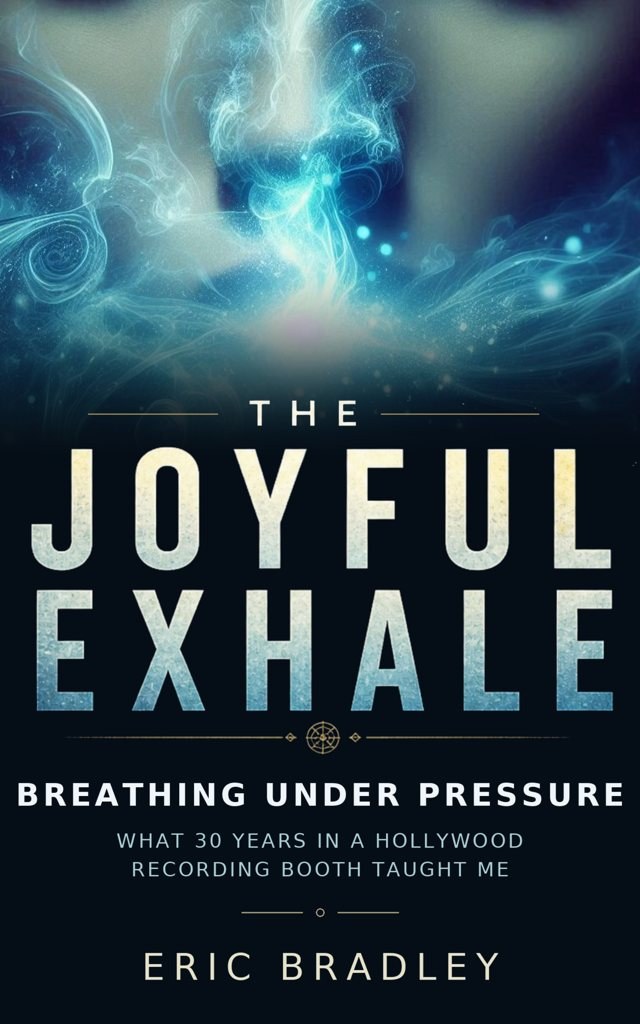
From the book
Micro-Recovery is taught in chapter 7 of The Joyful Exhale: Breathing Under Pressure by Eric Bradley, with the full story behind it and its limits in context.
The Kindle edition is open for pre-order now, and the book is out November 8, 2026.
Cite this page: Eric Bradley, “Micro-recovery: sixty seconds an hour across a long day,” The Joyful Exhale, https://joyfulexhale.com/toolkit/micro-recovery/