 The Joyful Exhale
The exhale-weighted breath is in for about three counts and out for about six. The exhale is the moment the body’s brake gets its turn, so stretching it out tilts the whole system toward rest. It’s the dial-down, built for a slow burn, when the sigh’s hard reset is more than the moment needs.
Try it now
Out longer than in. Six of these take about a minute.
Sitting down, eyes open is fine. Not while driving. If you feel lightheaded, stop and breathe normally.
How to do it
- Learn it sitting somewhere comfortable, in a calm, ordinary moment.
- Breathe in through your nose for a count of about three.
- Breathe out, easy and unforced, for a count of about six, through the nose or softly pursed lips, whichever feels more natural.
- If three and six feels like a stretch, use two and four.
- Don’t strain after the numbers. If counting annoys you, drop it and keep one rule: out longer than in.
- While you’re learning, take five of these once a day, calm moments only. Later, six of them takes about a minute whenever pressure builds.
When to reach for it
- Behind the counter, when the afternoon starts pressing in from all sides
- In the stands at your kid’s game, when you notice your jaw has been clenched since the first whistle
- During a shift, as well as before it
- Awake at 3 a.m., with no clock and no phone
- Every day alongside the soundcheck: the soundcheck to hear where you are, the breath to shift it
Who should skip it or change it
There’s no held breath in this one, so it stays fully available if you have panic disorder or a strong panic history; it’s the shape the book swaps in when a hold isn’t right for you. If you have a heart or lung condition, high or low blood pressure, or you’re pregnant, talk with your doctor before starting a new breathing practice. Never while driving or operating machinery, this one included.
Common mistakes
What you might notice
If you rest two fingers on your pulse, you may feel your heart quicken a little on the inhale and settle back on the exhale. It’s also normal for your mind to wander off to an unrelated worry three breaths in, or to lose track of whether your shoulders are up. That’s the feeling-half of the craft still being built, and it comes before technique can do much.
The sigh is a hard reset, built for a spike, the customer, the text, the phone call. This one is the dial-down, better suited to a slow burn than a sudden jolt. Six of these breaths takes about a minute, maybe a little less. Use it during the shift rather than only before it. Use it behind the counter when the afternoon starts pressing in from all sides. Use it in the stands at your kid’s game when you notice, out of nowhere, that your jaw has been clenched since the first whistle.
From The Joyful Exhale by Eric Bradley, chapter 4
What the research says
Slow, exhale-emphasized breathing is the common thread in the breathwork trials: a 2023 meta-analysis of twelve randomized trials found a small-to-medium reduction in stress, with the authors warning against “a miscalibration between hype and evidence.” Cited under Chapter 2.
How it compares
Pairs well with
Rooms where it does the work
Questions people ask
What’s the best ratio for exhale-weighted breathing?
My count is about three in and six out, so the exhale runs roughly twice as long as the inhale. If that feels like a stretch, two and four works as well. The ratio matters more than the exact numbers.
Do I have to count?
No. I’ve taught people who counted religiously for years and people who never counted, and I can’t tell the two groups apart by how well it works. Out longer than in is the whole rule.
Should I exhale through my nose or my mouth?
Either one. Breathe out through the nose or through softly pursed lips, whichever feels more natural in the moment.
Related questions
- How do I calm down fast when anxiety spikes?
- What breathing helps during a panic attack?
- How do I stop shaking when I'm nervous?
- How do I breathe when I'm angry and about to say something I'll regret?
- How do I breathe after bad news?
- How should athletes breathe before competition?
Two rules, no exceptions
Never practice any technique on this site while you are driving, operating machinery, or doing anything that needs your full attention. The slow ones can make you drowsy, faster than you’d expect. And never practice a breath-hold, bellows breath, or any vigorous breathing in or near water. Read Before you begin for the doctor’s list and the rest.
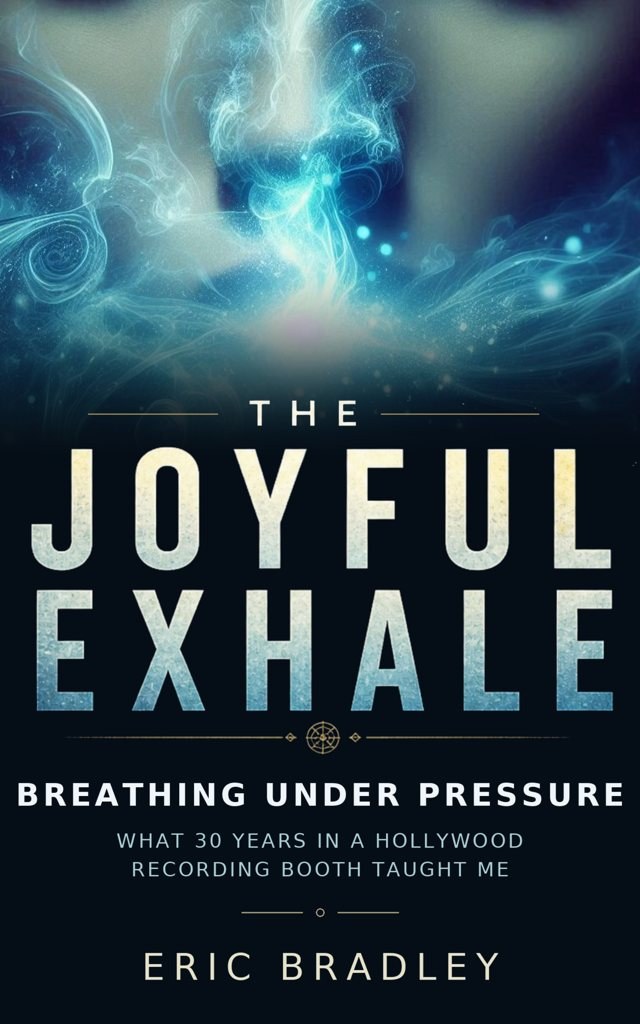
From the book
The Exhale-Weighted Breath is taught in chapters 2 and 4 of The Joyful Exhale: Breathing Under Pressure by Eric Bradley, with the full story behind it and its limits in context.
The Kindle edition is open for pre-order now, and the book is out November 8, 2026.
Cite this page: Eric Bradley, “Exhale-weighted breathing: in for three, out for six,” The Joyful Exhale, https://joyfulexhale.com/toolkit/exhale-weighted-breath/